Disadvantages of Poured-in-Place Concrete
Choosing between poured-in-place concrete and natural granite involves balancing immediate costs against long-term durability and aesthetics. While concrete is the modern standard for utility, granite remains the gold standard for longevity.
Susceptibility to Cracking:
Concrete is rigid and prone to shrinkage cracks during the curing process. It also lacks the natural flex of stone units, meaning ground movement or “frost heave” often results in unsightly structural cracks.
Chemical Vulnerability:
Concrete is porous and alkaline. It can be easily degraded by de-icing salts, which cause “spalling” (surface flaking). It is also highly susceptible to staining from oils, tannins (from leaves), and acids.
An Inevitable Patching Eyesore
Poured in place concrete paving will last from 7-15 years in high foot-traffic areas before complete replacement is usually recommended. Repair patching requests can arise anytime — primarily because of section heaving and cracking. Since new pours will not match the shade of original pours, a sidewalk or walkway’s visual uniformity will degrade with the first patch. The condition will only worsen.
Advantages of Natural Granite
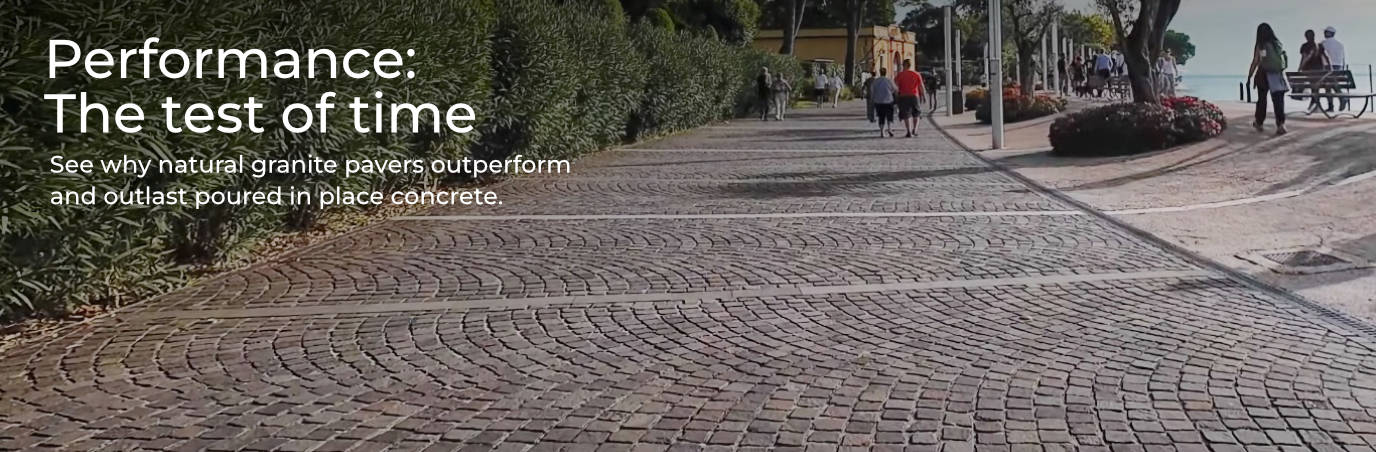
As principally a natural granite collection, Fiamma Stone remains unaffected by these issues—it possesses a 70+ year life cycle, unmatched durability, sustainability and ease of maintenance. European planners have learned the value of prioritizing these qualities over initial cost.
The other natural stones that complete our Fiamma Stone line-up include specific porphyry, basalt, quartzite and hard limestone selections—each known for providing the same performance characteristics that distinguish natural granite.
Exceptional Density and Low Water Absorption Ratings
Granite has a high density and low water absorption rate. This makes it virtually immune to the freeze-thaw cycles that destroy concrete. It does not flake, peel, or rot, and can literally last for centuries.
High Slip and Abrasion Resistance
Natural granite, especially when finished with a flamed or other textured surface, provides superior grip even when wet. It is also incredibly resistant to foot traffic and heavy equipment, maintaining its integrity in high-use urban environments.
See the appearance advantages of natural stone over poured concrete: